




Do not cancel the party and do not try to force a reconciliation on the night. Have a quiet, separate word with each person beforehand, set the event up so neither feels cornered, and let the business set the finish time and the drinks. Then deal with the real issue in the week after.
If you run a business with no HR team, two employees not speaking to each other is easy to manage around in a normal week. People use email, different rooms and a manager who passes messages along. The Christmas party removes those workarounds. Everyone is at the same venue, in the same photos, listening to the same toast.
This guide sets out what we would do, in order: before the party, on the night, in the week after, and when to bring in someone neutral. It works for owners, general managers and anyone running the event, from late November through to mid-January. Calm, clear and early is usually better than perfect and too late.
Key Takeaways
- Keep the party. Cancelling it tells the whole team there is a problem and punishes everyone for a conflict between two people.
- Have a short, private word with each person beforehand. Listen, ask what would help, and do not take sides or ask them to just be civil.
- Use no forced pairings or joint tasks. The business, not the individuals, sets the finish time, the drinks and the ways home.
- On the night, stay clear-headed, redirect early and separate people quietly. Nothing gets resolved at 10pm.
- The real work happens in the week after. Check in with each person and do not let it drift over the break.
- If you manage the people involved, you are not neutral. Bring in an outside neutral, and use a different process if the matter involves alleged bullying, harassment or safety.
Summary: The Party Timeline at a Glance
| Stage | What to do | What to avoid |
|---|---|---|
| Before the party | Have a private word with each person. Ask what would help. Send a positive note to the whole team | Taking sides, asking them to just be civil, calling a joint meeting |
| Event set-up | Mix the seating. Give each person their own role. Set the finish time, drinks and ways home | Forced pairings, joint tasks, singling anyone out |
| On the night | Stay clear-headed. Watch for flashpoints. Redirect and separate quietly if it flares | Holding a hearing, asking who started it, drinking heavily as host |
| The week after | Check in with each person separately. Decide which process fits | Waiting for it to settle over the break |
| When it needs a neutral | Start triage. Choose mediation, HR guidance, coaching or investigation to suit the matter | Mediating your own staff, or using mediation where there are serious concerns about conduct |
Why the Christmas party makes the silence visible
The party does not cause the conflict. It removes the hiding places. Two people can avoid each other all year through email, separate desks and a manager who relays messages, but a shared table, a group photo and a toast leave nowhere to go. The party is a deadline that makes the silence visible.
That visibility is useful. Conflict is not a bad word. Two employees not speaking to each other is usually a sign that something important needs attention, and the party has simply given you a date to act by.
Most workplace conflict starts small, with an issue everyone decides to manage around. By the time it surfaces, people are reacting to the silence, the delay and the sense of unfairness as much as to the original problem. Colleagues notice too. Some start to take sides, and others quietly work around the pair.
It is also rarely only two people. The silence between two employees often involves a manager who has been smoothing things over and a few colleagues who have been drawn in. Keep that wider picture in mind as you plan.
Before the party: have a quiet, separate word with each person
Talk to each person alone, a week or two before the event, and keep it short. Say that you have noticed the distance, that you are not asking them to fix it before the party, and that you want the night to work for them. Then listen more than you talk.
These are work Christmas party tips for managers that cost nothing and prevent most of the trouble. The aim is not to resolve anything. The aim is to make sure neither person walks in feeling ambushed, watched or cornered.
Sample lines for the separate word
Use your own words, but keep the shape. Say the same things, in the same tone, to both people.
I've noticed things have been tense between you and the other person. I'm not asking you to sort it out before the party.
I'd like the night to feel comfortable for you. Is there anything that would help, like where you sit or when you plan to head off?
Is there anything you'd like me to know before the night?
After the party, I'd like to sit down with you properly about how work has been going. Is that okay?
What to avoid in that conversation
Do not take sides. Even a nod, a sympathetic sigh or a comment like "I know what they're like" will be remembered and repeated. You may well agree with one person. Keep that to yourself.
Do not ask them to just be civil. It sounds reasonable, but it tells the person their problem is manners. It also sets a vague standard that is easy to break and easy to resent. Ask what would help instead.
Do not pass on what the other person said. Each conversation is private. If you start relaying, you become part of the conflict.
Do not make attendance sound like an order, or the chat sound like a warning. If someone would rather skip the party, hear them out. A conversation about what is making them uncomfortable is more useful than a lecture on team spirit.
If anything you hear sounds like alleged bullying, harassment or a safety concern, stop treating this as a party-planning problem. It needs a different process, which we cover below.
Set the event up so neither feels cornered
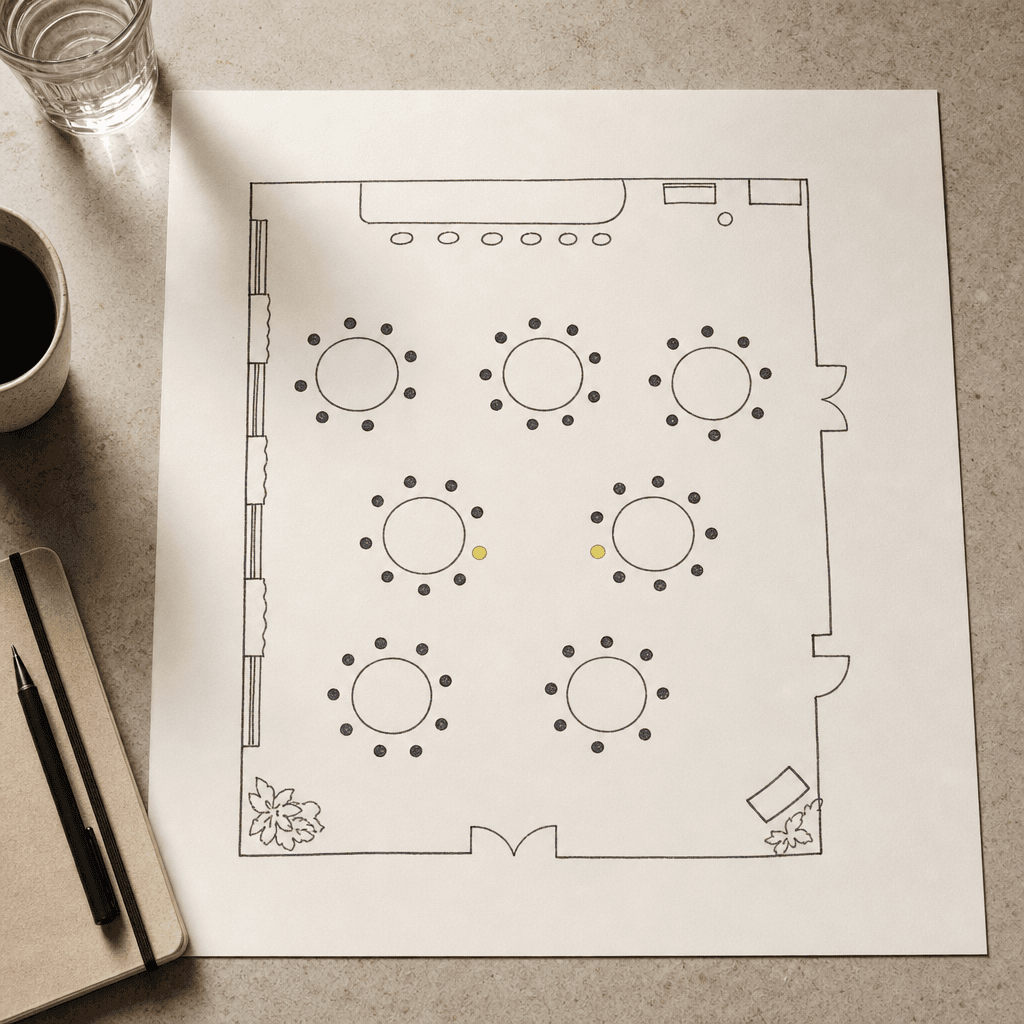
Plan the night so that neither person has to interact unless they choose to. That means no forced pairings, no joint tasks and no seating plan that puts them side by side or obviously at opposite ends. Include both fully, and make the structure of the evening do the work.
Seating and roles
Mix the tables so people sit with a range of colleagues. Do not seat the two together, and do not park them at opposite ends in a way that looks planned. Someone who sits at a table of people they like is more relaxed than someone who feels placed.
Give each person a role of their own if roles are handed out. One might welcome guests while the other sorts the music or the photos. Do not ask them to co-host, co-present or run the raffle together. If you run Secret Santa, check the draw so they are not paired, or skip it this time.
The business sets the finish time, the drinks and the trip home
The business, not the individuals, should set the limits. When the rules apply to everyone, nobody feels singled out, and you do not have to police two people on the night.
- Finish time. Choose a clear end and tell everyone in advance. A defined finish gives people an easy way to leave and stops the night drifting into the hours when things go wrong.
- Drinks. Decide how much the business will fund. Drink tickets, or a bar tab that closes at a set time, work well. Serve food early and offer good non-alcoholic options. Venues also have their own responsible service of alcohol obligations, which help you.
- Getting home. Arrange or fund safe ways home, such as rideshare vouchers or a transport plan, and say so in advance. Nobody should be driving or left to work out the trip alone.
A positive note to the whole team
Send a short message to everyone a few days out. It should thank the team for the year, say what the night is for, and cover the finish time, the drinks and the ways home. It should also say that everyone is welcome.
Thanks for a big year. The night is about all of us, so come as you are and enjoy it. We finish at the time on the invitation, there is food from the start, and we've organised ways home. Look out for each other.
This note is not aimed at the two people. It sets the tone for everyone, and it means the finish time and drinks limits read as normal rather than as a reaction to a problem.
On the night: stay clear-headed and watch for flashpoints
The host or manager should stay sober enough to notice and stay near the room rather than the bar. Watch for early signs: raised voices, a pointed comment, a group going quiet when someone walks past, one person hovering near the other. Step in early and lightly.
Managing staff conflict at the end of year party is mostly about noticing. The usual flashpoints are the second round of drinks, speeches and toasts, group photos, and the last hour when inhibitions are lowest. If you plan for those moments, you will be standing in the right place.
If it flares, redirect and separate quietly
An unplanned scene is not the time for a hearing. Walk over calmly, keep your voice low and say something simple like, "Can I grab you for a minute?" Move one person to another part of the room, offer water or food, and check how they plan to get home.
Do not ask who started it. Do not ask the people watching. Do not give a verdict. You are trying to lower the temperature and get everyone home safely.
If the situation involves a threat, physical contact or anything that looks like harassment, safety comes first. Separate people, make sure everyone gets home safely, and treat it afterwards as a different kind of matter.
Nothing gets resolved at 10pm
Do not try to get an apology, a handshake or a promise to move on. People who have been drinking, with an audience, and with the heat of the moment still on them, rarely say what they mean. A forced reconciliation at that hour tends to harden positions.
Send each person a short message the next day, saying you are glad they came and that you will catch up in the coming week. That is enough.
The week after: check in with each person
Check in with each person individually within the week after the party, and again before the break if you can. Ask how the night went and what they would like to happen next. Do not let it drift into the holidays, because silence and delay make conflict harder to resolve.
Why delay and silence make it harder
The holiday break turns a pause into weeks. Each person spends that time rehearsing their own version of events, and the story sets. Colleagues talk, some pick sides, and the person who felt wronged also starts to feel ignored. When everyone returns, the original issue is still there, with extra layers added.
The silence itself becomes a grievance. People often say the lack of response bothered them more than the original problem. That is why workplace conflict over the holiday break so often looks worse in January than it did in December.
If you are reading this after the party, or after the break has started, the steps are the same. A check-in in mid-January is better than none. We cover the timing question in our article on whether to mediate before Christmas or wait until January, so we will not repeat it here.
What to ask in the check-in
Keep the questions open and identical for both people, and give each the same time and tone.
- How are you finding working with the other person at the moment?
- What is the main thing that needs to change?
- What have you already tried?
- What would a better working relationship look like in practice?
You are not looking for a verdict. You are working out what kind of problem you have.
Choose the right process
Not every matter needs the same process. After the check-ins, you are usually looking at one of five paths:
- A management decision, such as clarifying roles or changing who works with whom, when the issue is structural.
- HR guidance, when you are unsure of your options or need help handling the conversations well.
- Conflict coaching, when a leader needs support to handle the situation themselves.
- Mediation, when two or more people need to agree how they will work together.
- An independent investigation, when there are concerns or complaints that need facts established.
Choosing the right path is often the hardest part, and the cost of choosing wrongly is time, trust and money.
When to bring in a neutral
Bring in a neutral when a quiet word has not broken the silence, or when you are too close to the people involved. You can't be neutral about your own people, and they know it. An outside mediator is someone on nobody's side, which is exactly what the conversation needs.
If you manage either person, have advised one side, or will decide the outcome, you are not neutral. That is not a criticism of you. It is a feature of the role. Both people read your involvement through that lens, however fair you are trying to be.
Mediation and investigation answer different questions
Mediation asks what happens next. An investigation asks what happened. That difference decides which one you need.
Mediation is voluntary and confidential. The mediator does not decide who is right. The people involved agree what happens next, and a short outcome note records it. It suits a working relationship that has broken down without any suggestion of misconduct.
If the matter involves alleged bullying, harassment or a safety concern, a different process may be needed, such as an independent investigation. Safe Work Australia describes workplace bullying as repeated and unreasonable behaviour that creates a risk to health and safety, and distinguishes it from reasonable management action carried out reasonably. An investigation is scoped first, and the estimate follows the scoping. We use the word concerns or complaints in the early stages, and allegations only once they are formally framed.
We do not give legal advice, and we are not a law firm. Questions about your obligations, a dismissal or a claim are for a lawyer.
How to get started
Every matter starts with triage. The free option is a conversation of about ten minutes with the Conflict Services AI Concierge, by voice or online chat, at our booking page. It asks what is happening, who is involved and what you want from the process, and takes notes for our team. It does not give advice or comment on anyone's conduct, and you can ask for a human at any time.
Our team then matches the right person on the panel, checks for conflicts of interest and replies within two business days with who that is, how it would run and the fee. If you would rather speak with a person, you can book a 45-minute triage call with an accredited mediator for $290 ex GST, followed by a short email of next-step recommendations.
Workplace mediation is run by video anywhere in Australia, or in person on request. A half-day session is $2,900 ex GST, for 3.5 hours and two participants. If you need help with the management side, such as how to handle the conversations or what your options are, HR guidance is billed by the hour with no retainer.
For workplace mediation in Australia, the order is the same each time. We call it what happens, in order:
- Free triage, to gather the facts and match the right person.
- Invitations, so each person is asked to take part rather than told.
- Separate preparation, a private conversation with each person before any joint session.
- The session, with separate private rooms available.
- Outcome note, a short record of what the people agreed.
If any of your staff are invited to mediation, our team mediation "what to expect" article explains the process in plain terms.
Treat the party as a deadline, not a venue
The party is not where this gets fixed. It is a deadline, and a deadline is useful because it forces a decision. Most owners treat the silence as something to survive until January. We treat it as information, because two people not speaking is a sign that something important needs attention.
Imagine a 45-person trades and services business. An operations manager and a senior team member have stopped speaking directly. Both still do their jobs, but two people on the team have asked for transfers, and the owner has been hoping the party will smooth things over. There is no HR team.
There are two ways to approach the night. The owner can hope, perhaps seat the pair together and ask them to be civil. Or the owner can have a quiet word with each person, set the finish time and drinks, stay clear-headed on the night, and check in with each of them the following week.
The second path does not guarantee a resolution, and we would not promise one. What it gives the owner by the end of the week is a clearer picture. Both people have been heard separately and neither was surprised on the night. There is also enough information to decide the right process. Here there is no allegation of misconduct, so mediation rather than an investigation is the likely fit, and the owner can start triage before the break rather than after it.
That is the contrarian part of our view. Cancelling the party, or staging a reconciliation at it, treats conflict as something shameful that needs to be hidden or stamped out. Hidden conflict does not go away. It goes underground, where it grows.
If two of your team are not speaking, start with the free triage at our booking page. The process is the same over the break.
References
Questions
Other questions people ask
- Should I cancel the Christmas party because two employees aren't speaking?
- No. Cancelling punishes the whole team for a conflict between two people and signals that something is wrong. Keep the party, speak to each person privately beforehand, set the finish time and drinks yourself, and deal with the underlying issue in the week after.
- Should I ask two employees who aren't speaking to just be civil at the party?
- We would not. It treats the problem as a question of manners, sets a vague standard and often leaves people feeling dismissed. Ask each person what would help them get through the night, such as seating or when they plan to leave, and leave the real conversation for afterwards.
- What should I do if the conflict flares up at the party?
- Redirect and separate quietly. Walk over calmly, ask to speak to one person for a minute, move them to another part of the room and check how they are getting home. Do not ask who started it or try to resolve it. If there is a threat or a safety concern, put safety first.
- Am I responsible for what happens at a work Christmas party?
- Work events can be treated as connected to work, and whether a particular situation creates obligations is a legal question for a lawyer. Practically, plan the event with a finish time, drinks limits and safe ways home, make expectations clear and respond promptly if something goes wrong.
- How do I get help with workplace conflict over the holiday break?
- Start with free triage at the booking page. The AI Concierge takes about ten minutes by voice or chat, and our team replies within two business days with who would help, how it would run and the fee. You can also book a 45-minute call with a mediator for $290 ex GST. The process is the same over the break.
Written by
Conflict Services
Mediators, an investigator, a leadership coach and HR and governance specialists, matched to the matter.


General information only, not legal advice. Conflict Services provides mediation, HR guidance and policy review.