



Business partner mediation in Australia through Conflict Services costs nothing to start. Triage with the AI Concierge is free, a 45-minute call with an accredited mediator is $290, a half-day session for two partners is $2,900 and a full day is $4,900. All prices are ex GST. Matters with more than two participants are scoped at triage.
Most co-owners in a dispute know something is wrong but are unsure that neutral help can simply be booked. It can. This guide is written for partners, not employers. It sets out what two co-owners actually pay to work through a disagreement about direction, money, roles or exit, and which format fits which dispute.
It is also written for partners who have been invited to mediation by the other side. If that is you, the section on how a session runs, step by step, explains what you are being asked to do and what you are not.
Key Takeaways
- Starting costs nothing. Triage with the AI Concierge is free, and a human option is a 45-minute mediator call at $290 ex GST.
- A half-day ($2,900 ex GST, 3.5 hours) suits one defined issue. A full day ($4,900 ex GST, 7 hours) suits layered disputes covering strategy, money, roles and exit.
- Matters with more than two participants, including many family businesses, are scoped at triage rather than priced off a menu.
- One partner can't mediate the other. You can't be neutral about your own people, and they know it.
- A stalemate has no price list, but it still costs. Calm, clear and early is usually better than perfect and too late.
Summary Table
| Option | What it is | Best suited to | Commitment |
|---|---|---|---|
| Free triage | AI Concierge conversation by voice or chat, then a reply from our team | Partners who want to start now and have the facts noted | None |
| Paid triage call | A call with an accredited mediator, plus emailed next-step recommendations | Partners who would rather speak to a person first | None beyond the call fee |
| Half-day mediation | Shorter session for two participants | One defined issue, such as how decisions are divided | Fee agreed before booking |
| Full-day mediation | Full session, with separate preparation first | Layered disputes across strategy, money, roles and exit | Fee agreed before booking |
| More than two participants | Scoped individually at triage | Family businesses and multi-owner matters | Fee agreed before booking |
| Optional extras | Conflict coaching for leaders, HR guidance by the hour | Support around the session | Optional, no retainer |
What does business partner mediation cost in Australia?
Conflict Services charges four published fees for business partner disputes, all ex GST: free triage with the AI Concierge, $290 for a 45-minute mediator call, $2,900 for a half-day and $4,900 for a full day. Nothing is booked or paid until we have matched you with a practitioner and they have agreed the fee.
Source: Conflict Services published fees, ex GST, as listed on the booking page.
| Option | Price (ex GST) | Format |
|---|---|---|
| Triage with the AI Concierge | Free | About 10 minutes, voice or chat |
| Triage call with an accredited mediator | $290 | 45 minutes, plus a short email of next-step recommendations |
| Half-day mediation | $2,900 | 3.5-hour session, two participants |
| Full-day mediation | $4,900 | 7 hours |
GST is added on top of these amounts. The same prices apply whether you are two co-owners in a company, partners in a practice or members of a family business. The format changes with the dispute, not with the label on the business.
We do not publish market averages or compare other providers' fees here. This page covers what we charge, so you can put a known number in your budget. If you want to map the costs against your own situation, the free cost and process planner walks through it.
Step one: which triage option should you use?
Every matter starts with triage. Use the free AI Concierge for about 10 minutes by voice or chat, or book a 45-minute call with an accredited mediator for $290 ex GST. Both end with a recommendation from our team on what fits your dispute.
The free AI Concierge
The AI Concierge is an AI assistant on our booking page. It asks what is happening, who is involved and what you want from the process, and it takes notes for our team. It never gives advice, never decides anything and never comments on anyone's conduct. You can ask for a human at any time.
Our team then matches the right person on the panel, checks for conflicts of interest and replies within two business days. The reply says who that person is, how the process would run and what the fee would be. It suits partners who want to get the facts down quickly, outside business hours, or without having to explain the situation out loud to a stranger first.
The $290 mediator call
Some people would rather speak with a person. For $290 ex GST you can book a 45-minute triage call with an accredited mediator from our panel. It is followed by a short email of next-step recommendations. There is no obligation to go further, and the fee is not discounted off a later mediation.
This option suits partners who are unsure what kind of problem they have. Not every matter needs the same process. Some need a clear decision between the partners, some need coaching, some need mediation and some need advice from a lawyer or accountant. A mediator on a call can help you sort which is which.
If you are not ready for either, two free tools help you get your thoughts in order first: the partner dispute checklist and the two-minute Conflict Check.
Half-day or full-day mediation for co-owners?

A half-day is $2,900 ex GST for a 3.5-hour session with two participants, and suits one defined issue. A full day is $4,900 ex GST for 7 hours and suits layered disputes covering strategy, money, roles and exit. Choose by the number of issues, not the size of the business.
When a half-day fits
A half-day works when the disagreement has a clear edge. Examples include how decisions are divided between two partners, who handles a particular part of the operation, or how the two of you communicate when you disagree. There is one subject, two people and a realistic chance of agreeing what happens next inside 3.5 hours.
When a full day fits
A full day is used for business partner disputes and complex matters. Co-owner disputes are often layered. A disagreement about expansion is rarely only about expansion. It brings in money (reinvest or draw out), roles (who runs what) and exit (what happens if one of you wants out). Those threads pull on each other, so trying to settle one in isolation often leaves the others unresolved.
A full day gives the room to move between them. Separate preparation conversations come first, so each partner can set out their priorities and non-negotiables before the joint session.
An illustrative scenario
This is a hypothetical example, not a real matter. Imagine two co-owners of a family-run business with about 30 staff. One wants to open a second site. The other wants to hold steady and draw more from the profits. Over a year, meetings have been avoided, decisions are being made by email and staff are being asked which side they are on. Neither partner wants to start a legal process yet.
One of them uses the partner dispute checklist and starts a free triage. Our team's recommendation is a full day, because the expansion question is tangled up with drawings, roles and what happens if the plan fails. Each partner has a separate preparation conversation. On the day, the mediator keeps the process neutral and the partners work through the issues in order. They agree what happens next, and a short outcome note records it. Any legal or financial questions go to their own advisers.
The point is not the result, which belongs to the partners. The point is that the cost was known before they began: $4,900 ex GST, not an open-ended meter.
More than two participants
Many disputes involve more than two people, especially in family businesses where siblings, parents or an adult child are co-owners. These are scoped at triage rather than priced off a menu. As a guide, each extra participant adds about $700 ex GST, and the final fee is agreed with you before anything is booked.
Why can't one partner mediate the other?
A mediator has to be neutral, and a co-owner never is. You have a stake in the outcome, a history with your partner and a view on who is right. You can't be neutral about your own people, and they know it. Someone from outside has to run the conversation.
This catches out capable owners. A founder who has managed people for years assumes they can sit the other partner down and settle it. But the other partner doesn't hear a neutral. They hear the other side of the argument. The same applies to a trusted friend, a family elder or an accountant who has advised one of you.
A mediator needs to be someone on nobody's side. Conflict Services will not mediate a matter it has advised on. If an independent investigation has taken place, a different panel member mediates.
Conflict is not a bad word. It is usually a sign that something important needs attention. Partners who treat it as shameful tend to avoid it, and avoided conflict grows. Treat it as information, and an outside mediator gives you a structured place to act on it.
One boundary matters here. Conflict Services is not a law firm and gives no legal advice. The mediator does not decide who is right. Questions about shares, partnership or shareholder agreements and entitlements are questions for a lawyer. Mediation covers what happens next, and the partners own that decision.
What happens, in order, if you have been invited to mediation?
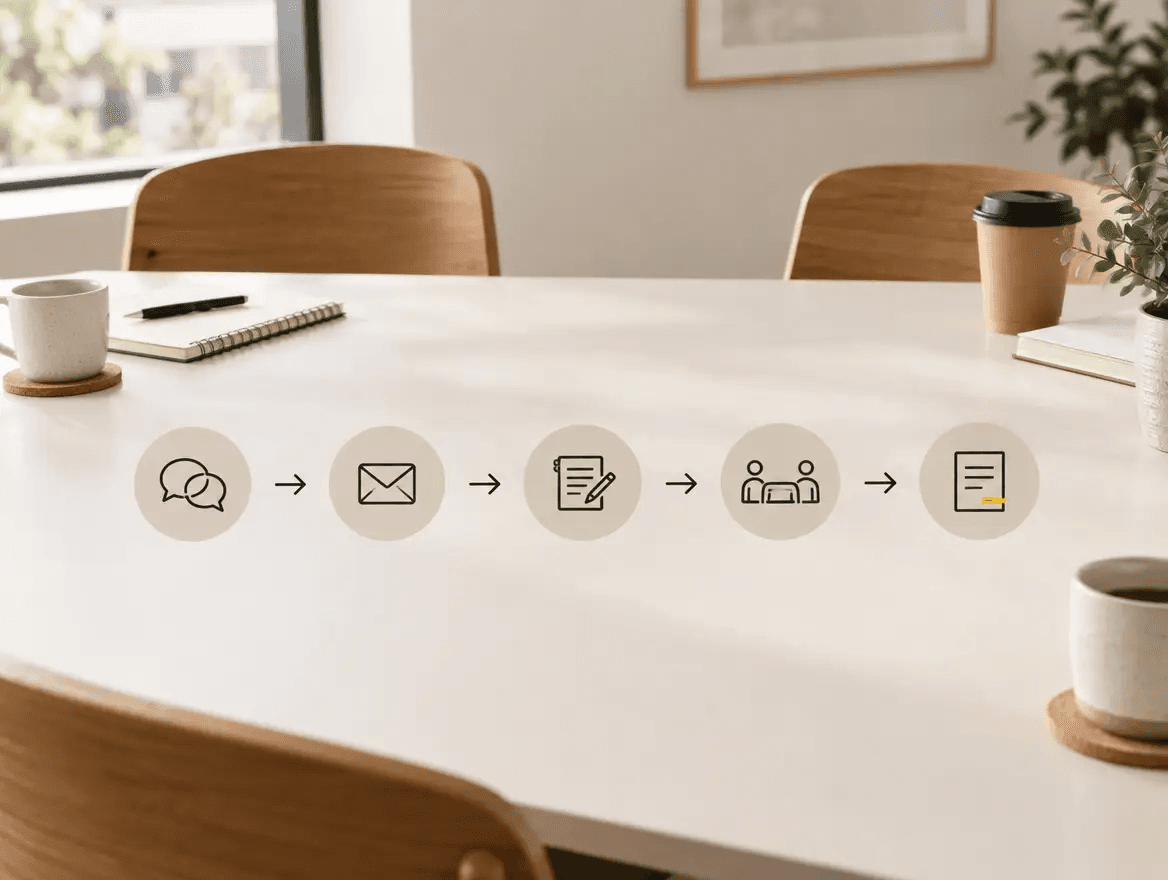
Mediation runs in five steps: free triage, invitations, separate preparation, the session and an outcome note. It is voluntary and confidential. The mediator does not decide who is right. You and your partner agree what happens next, and a short note records it.
If the other partner has started the process, you are not walking into an ambush. Here is the sequence.
- Free triage. The partner who starts the process talks to the AI Concierge, or books the $290 mediator call. Our team matches a practitioner, checks for conflicts of interest and replies with who, how and the fee.
- Invitations. The other partner is invited to take part. Mediation is voluntary, so you can ask questions first. Nobody is forced to attend.
- Separate preparation. Before any joint session, the mediator speaks with each partner privately. This is where you set out what matters to you and what you will not move on. You are not ambushed on the day.
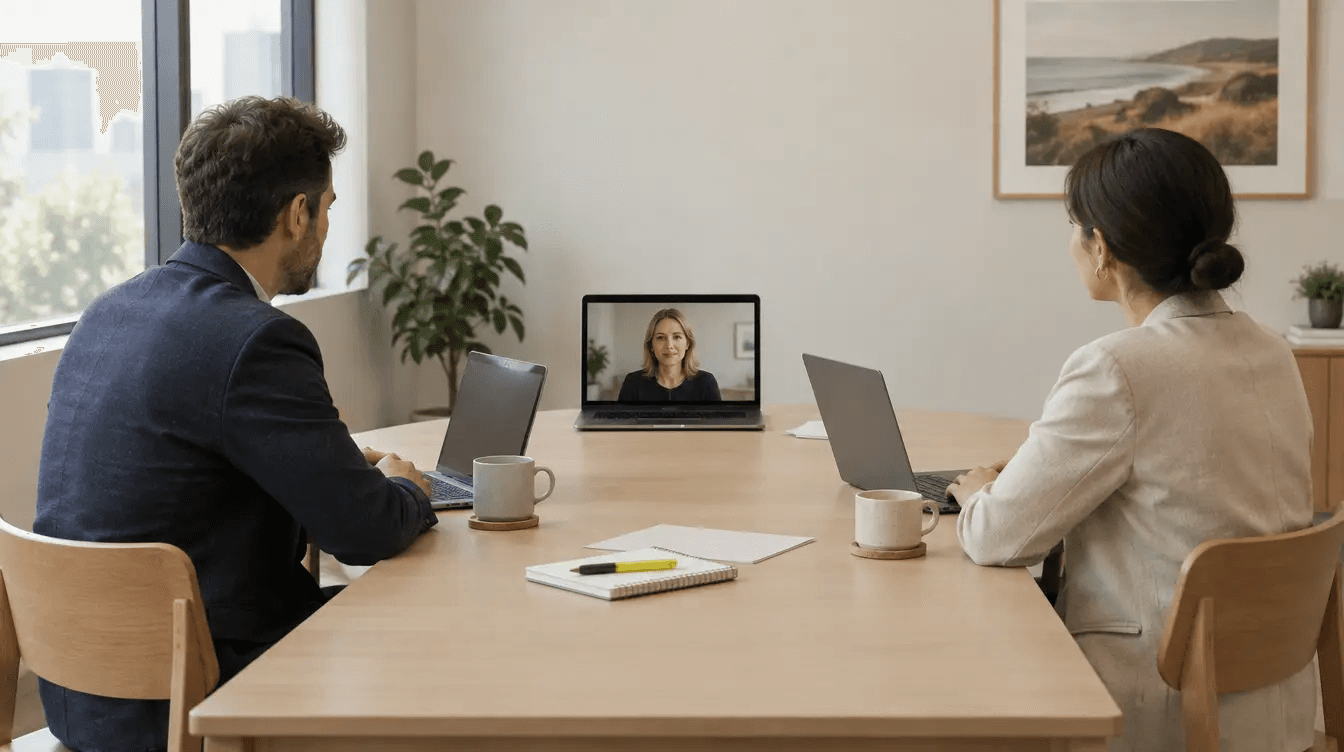
- The session. Sessions run by video anywhere in Australia, with separate private rooms, and in person on request. The mediator runs the conversation and keeps it on track. You decide what you agree.
- Outcome note. A short note records what you agreed. It covers things like how decisions will be made, how often you meet and when an outside adviser is brought in.
If you are unsure where to begin, start in the middle. You don't need the whole dispute mapped out. You need to say what is happening and what you want from the process.
What can sit around the session?
Two optional extras can sit around mediation: conflict coaching for leaders at $1,290 ex GST for four one-hour sessions and a plan, and HR guidance at $290 ex GST an hour with no retainer. Neither is required, and neither replaces the mediation itself.
Conflict coaching suits a partner who wants to handle hard conversations better, whether before, during or after the mediation. It runs as four one-hour sessions with our leadership coach and finishes with a written plan.
HR guidance suits the business side of a partner dispute, particularly when you employ staff and have no HR team. Examples include how to talk to the team while the partners are working things out, or how a policy should handle conflict going forward. You pay by the hour, with no retainer and no lock-in contract.
One caution. We will not mediate a matter we have advised on. So if you want guidance on the dispute itself rather than the wider business, tell us at triage. We will match the right person to the right job.
How do you get a quote and book?
Start at the booking page. Use the AI Concierge or book the $290 mediator call. Our team matches you with a panel practitioner, checks for conflicts of interest and replies within two business days with who it is, how it would run and the fee. There are no retainers and no lock-in contracts.
That reply is your quote. It is a fixed fee for the format, agreed before you commit. Nothing is booked or paid until a practitioner has agreed it.
You may be wondering whether you should talk to a legal professional first. That depends on the question. If it is about shares, a partnership or shareholder agreement, or a claim, that is a question for a lawyer, and mediation does not replace it. If the question is how the two of you move forward, that is what mediation is for. Many partners do both. The business partner disputes service page explains where mediation fits, and you can start triage or book the call here.
What does waiting cost?
Waiting rarely stays free. By the time conflict surfaces, partners are reacting to the silence, the delay and the sense of unfairness as much as to the original issue. A stalemate has no price list, but it still costs in stalled decisions, strained staff and narrowing options.
Most partner disputes start small. One decision is deferred. A conversation is avoided. Each partner decides to manage around it. Then meetings are skipped, decisions move to email and staff start to notice. At that point, the original disagreement is only part of what you are dealing with.
The earlier you act, the less there is to unwind. Calm, clear and early is usually better than perfect and too late.
That does not mean every dispute should go straight to mediation. Not every matter needs the same process. Sometimes the right first step is a decision, a conversation with your accountant or advice from a lawyer. Triage exists to work that out before you spend on the wrong thing.
The stalemate with no invoice
Here is what we think most partners get wrong about mediation cost: they compare $4,900 with nothing. That is the wrong comparison, because the stalemate never sends an invoice. It costs in ways nobody tallies, such as the decision that took six weeks, the staff member who stopped raising ideas or the opportunity one partner quietly stopped chasing.
The better question is whether you would rather carry a known cost or an unknown one. Mediation is the rare option in a partner dispute where the price is published, the time is fixed and the scope is agreed before you begin.
There are a few practical points that follow from that:
- Size the session to the dispute. A half-day aimed at a layered dispute can leave money, roles and exit half-discussed. The saving then turns into a second session. If the dispute spans strategy, money, roles and exit, the full day is usually the honest answer.
- Be clear on the maths. Free triage followed by a full day is $4,900 ex GST. A paid mediator call followed by a full day is $5,190 ex GST, because the $290 is not discounted off the mediation. Choose the paid call because you want to talk to a person, not to save money.
- Don't let the invitation be the obstacle. If you are the partner who was invited, the easiest next step is a question at triage, not a yes or no. Mediation is voluntary and the preparation is private.
Partners often assume mediation is a last resort. We see it differently. It is a sensible early step, because it is easier to agree how you will work together while you are still talking than after you have stopped.
Next steps
If you are ready, start free triage with the AI Concierge or book the $290 mediator call. If you want to plan your budget first, use the free cost and process planner. The earlier you start, the more options you have.
References
Questions
Other questions people ask
- How much does business partner mediation cost in Australia?
- Through Conflict Services, triage with the AI Concierge is free. A 45-minute mediator call is $290, a half-day mediation is $2,900 and a full day is $4,900, all ex GST. Matters with more than two participants are scoped at triage, with about $700 ex GST per extra participant as a guide.
- Is the free triage really free?
- Yes. The AI Concierge conversation takes about 10 minutes by voice or online chat. It gathers the facts so our team can match the right person on the panel. The team replies within two business days with who that is, how the process would run and the fee. Nothing is booked or paid until a practitioner has agreed the fee.
- Do both business partners have to agree to mediation?
- Yes. Mediation is voluntary and confidential. One partner can start triage, and the other is invited to take part. Each partner has a separate preparation conversation before any joint session. Nobody is forced to attend, and nobody is told what to agree.
- Can business partner mediation be done online?
- Yes. Sessions run by video anywhere in Australia, with separate private rooms. In-person sessions are available on request. The price for each format is the same whether you meet on video or in person.
- Does mediation replace legal advice about shares or agreements?
- No. Questions about shares, agreements and entitlements are for a lawyer. Mediation is about what happens next between the partners. The mediator does not decide who is right, and a short outcome note records what you agree.
Written by
Conflict Services
Mediators, an investigator, a leadership coach and HR and governance specialists, matched to the matter.


General information only, not legal advice. Conflict Services provides mediation, HR guidance and policy review.