



In a well-run workplace mediation, an independent mediator speaks privately with each person first, agrees ground rules, gives both equal airtime, uses private breakouts when needed, and helps you agree what happens next in writing. If your session felt horrific, it was most likely a manager-run chat, not mediation.
If you have just sat through a tense session with a coworker and feel worse than before, you are not alone, and you did not fail. Many people meet a badly run conversation first and assume that is what mediation is. It is not, and the conflict is not unfixable because the first attempt went poorly.
This article explains why manager-run sessions so often go wrong, what a neutral process actually involves, what you can do yourself this week, and how to ask your employer for an independent mediator without turning it into another argument. If you are the owner or manager who ran the session, it is written fairly for you too.
Key Takeaways
- A session that felt horrific was most likely a manager-run conversation, not mediation. A bad first attempt says little about whether the conflict can be resolved.
- Real mediation starts with private conversations with each person, not a joint meeting.
- The mediator does not decide who is right. People agree what happens next, and a short outcome note records it.
- You can prepare yourself: write down what happened, what matters to you, what "workable" looks like and what you need to feel safe.
- Not every matter needs the same process. Some situations call for an investigation, HR guidance or a management decision instead.
- Calm, clear and early is usually better than perfect and too late.
Summary: Manager-Run Chat Versus Independent Mediation
| Feature | Manager-run chat | Independent mediation |
|---|---|---|
| Who runs it | Someone who manages, or may decide about, one or both people | A mediator who is on nobody's side |
| Preparation | Usually little or none | Separate private conversation with each person first |
| First step | Joint meeting | Private preparation, then a joint session only if people are ready |
| Airtime | Often uneven, shaped by seniority | Deliberately equal |
| Private time during the session | Rarely available | Private breakout rooms when needed |
| Who decides | The manager, openly or quietly | The people involved |
| Question asked | What happened and who is at fault | What happens next |
| Outcome | Verbal, or felt to be decided in advance | A short written note both people keep |
What probably went wrong, and what to do now
Most likely, you sat through a well-meant conversation run by someone who was not neutral, with no preparation and no private time first. That is not mediation, and it is not a verdict on you or on the conflict. Take a breath, stop replaying it with your coworker, and work out what you would need to feel safe next time.
It makes sense that you feel worse. A joint conversation without preparation tends to surface everything at once, in front of someone with a stake in the result. People walk out feeling judged, exposed or unheard, and often more entrenched than when they walked in.
Here is what we suggest, in order.
Pause. Give yourself a day or two. Nothing about the conflict is made worse by a calm pause, and a lot can be made worse by a heated follow-up conversation.
Avoid rehashing it with the coworker. Going back over who said what usually restarts the same argument. A short, kind line is enough: "That meeting didn't go well for either of us. I'd like us both to have time to think before we talk about it again."
Note what you would need next time. Maybe you need to speak to someone separately first. Maybe you need a set agenda, a slower pace, or someone who is not your boss in the room. You do not have to solve the conflict this week. You only need to know what a safer process would look like.
Conflict is not a bad word. It is usually a sign that something important needs attention. A session that went badly is information about the process, and it tells you what to ask for next.
Why manager-run sessions often go badly
Manager-run sessions often go badly because the person running them is not neutral, has not prepared either side, and opens with a joint meeting. Add a power imbalance and an outcome that feels decided in advance, and even a kind, well-intentioned manager will struggle to make anyone feel heard.

This is not a criticism of managers. Most step in because they care, because they have no one else to call, or because they hope a quick chat will settle things. In small and mid-sized Australian businesses without an HR team, the manager is often the only option. The structure is the problem, not the person.
No neutrality
You can't be neutral about your own people, and they know it. A manager who supervises one or both people, has already heard one side, or will decide the outcome is not neutral, however fair they try to be. Each person watches for signs of who the manager believes, and that watching changes what they say.
No preparation
Without preparation, people arrive carrying months of frustration and no plan for how to say it. They have not had a chance to sort what is a fact, what is a feeling and what they actually want. So the first time they say it out loud is in front of the person they are in conflict with.
A joint meeting first
Starting with both people in a room asks them to be at their calmest at their most exposed. Careful mediation does the opposite. It starts in separate conversations, so each person can be heard without an audience. A joint session comes later, and only if people are ready.
A power imbalance
Even a friendly manager holds power over rosters, reviews, projects and references. People know this. Many quietly choose the safe answer instead of the true one. A junior employee facing a senior colleague with the boss in the room is in a very uneven position.
An outcome that feels decided in advance
When the person running the meeting will also decide what happens, people read every comment as a possible verdict. Some defend. Some say what they think the manager wants to hear. Others go quiet. None of these helps the two people work out how to work together.
What happens in workplace mediation done properly
In properly run workplace mediation, a mediator who is on nobody's side meets each person privately, agrees ground rules, gives equal airtime and offers private breakouts. The mediator does not decide who is right. The two people agree what happens next, and a short written note records it.
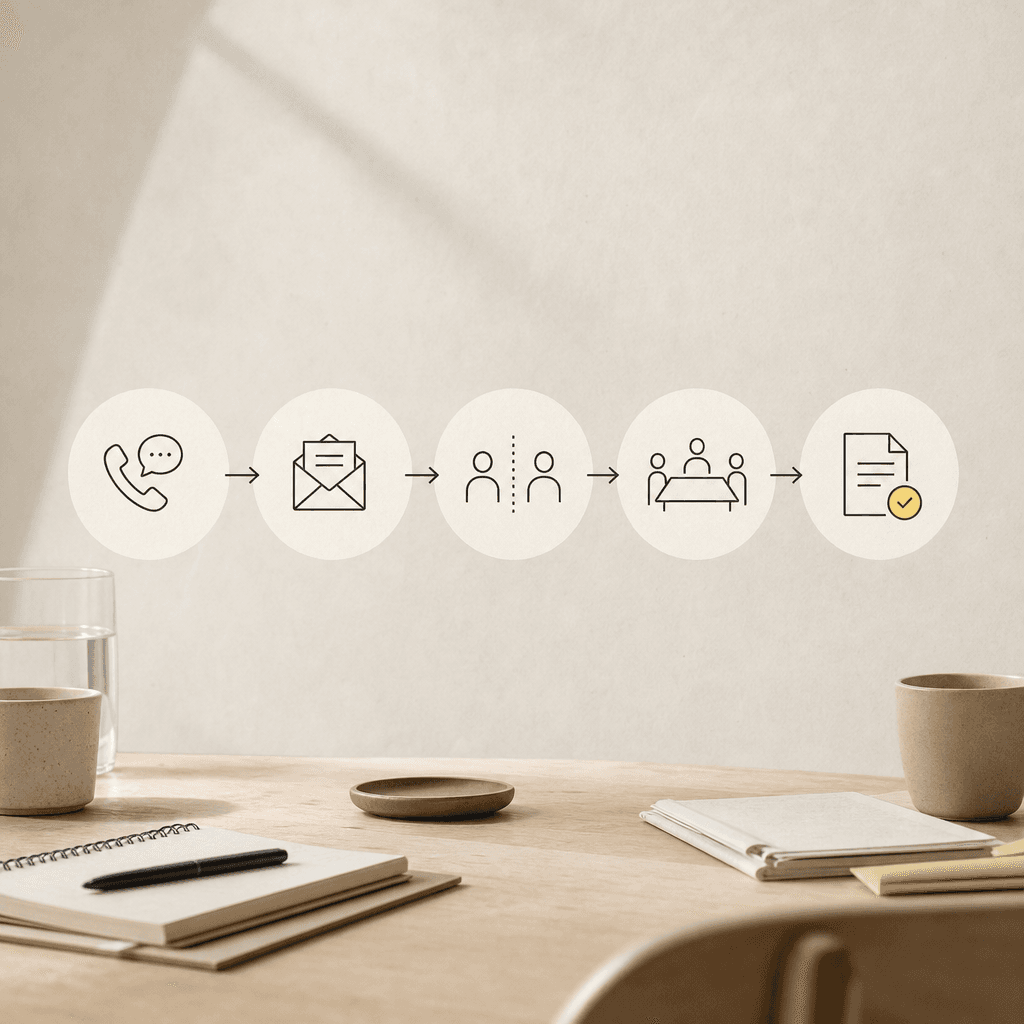
The process has a clear order. We call it "What happens, in order": a triage call, invitations, separate preparation, the session and an outcome note. This is what to expect at workplace mediation, whether it is with a coworker, a manager or a small team.
1. Triage call
Before any mediation, someone (usually the owner, manager or HR lead) has a short call to work out whether mediation is the right process at all. The triage call is 45 minutes and ends with a short email of next-step recommendations. Sometimes the recommendation is mediation. Sometimes it is something else, which we cover below.
2. Invitations
Each person is invited, not summoned. Mediation is voluntary and confidential, so people should be told what it is, who the mediator is and what to expect. Nobody should walk in not knowing what the meeting is for.
3. Separate preparation
The mediator speaks privately with each person before any joint session. Each person explains what happened from their side, what matters to them and what they want to be different. The mediator explains how the session will run and answers questions. This is also where a person can say they are not ready, or what they would need in order to feel safe.
4. The session
The session runs by video anywhere in Australia, with separate private rooms, or in person on request. A well-run session usually includes:
- Agreed ground rules, such as no interrupting, no raised voices and a pause whenever either person asks for one.
- Equal airtime, so each person can explain their view without being cut off or corrected.
- Private breakouts, where the mediator meets each person alone during the session to test ideas, check how they are going or give them a break.
- A mediator who does not decide who is right. The mediator manages the process, asks questions and helps people say what they actually need. The mediator does not judge or take sides.
- Practical options. The conversation turns from what went wrong to what should happen next: how you communicate, who decides what, and how you will raise issues early.
A half-day session is 3.5 hours for two participants. Many matters involve three, four or a whole team, so extra participants can be added.
5. Outcome note
If the people reach an agreement, a short written note records it. Both people keep a copy. It covers practical points such as how you will communicate, how decisions will be made and when you will check in. It is not a finding about who was right. Where someone has a legal or financial question, they take it to their own adviser.
Illustrative example: the same pair, two ways
This is a composite scenario, not a real case. Imagine a 40-person services business where an operations coordinator and a senior team member have stopped speaking directly. Their manager calls them both into the office.
In the manager's office, the coordinator speaks first and lists several incidents. The senior team member responds with their own list. The manager, who has heard bits of both stories in the corridor, tries to sum up and suggests they both "meet in the middle". Both leave feeling the manager sided with the other person. They go back to avoiding each other, and one now avoids the manager too.
Now imagine the same pair after private pre-meetings with an independent mediator. In their separate conversations, the coordinator explains that what bothers them most is being left out of decisions that affect their work. The senior team member explains they felt undermined in front of a client and have been cautious since. Neither had said these things to the other.
In the joint session, each speaks without interruption. In a private breakout, the mediator helps the senior team member find words for what they want to say. The two agree how decisions affecting the coordinator's work will be shared, how they will raise concerns and when they will check in. The agreement is written down and both keep a copy.
Same people, same history. The difference is the process: private first, equal airtime, someone on nobody's side, and a focus on what happens next.
What you can do yourself before anything else
You can prepare without anyone's permission. Write down what happened, what matters to you and what "workable" would look like, then note what you need to feel safe in a future conversation. This takes about an hour, and it makes any later mediation or conversation calmer and clearer.
Here is a simple way to do it.
Write down what happened. Keep it short and factual: a few dates, a few examples, what was said or done. Leave out guesses about motives. You are not building a case. You are getting clear.
Write down what matters to you. Conflict often looks like a fight about a task or a tone, but underneath it is usually something else, such as respect, workload, being consulted or feeling safe to raise concerns.
Picture "workable". You do not need to be friends. Ask yourself what would make working together manageable. Maybe it is a weekly check-in, a clear split of decisions or agreement to raise issues within a day or two. A clear picture of workable is far more useful than a wish for things to be perfect.
Note what you would need to feel safe. That might be a private conversation first, a fixed end time, a written agenda, or someone who has no say in your job. You can ask for any of these.
Two free tools can help. The two-minute Conflict Check on our site helps you sort what kind of situation you are in. The first 48 hours guide covers what to do, and what to avoid, in the first couple of days after a conflict surfaces. Both are free and neither commits you to anything.
How to raise it with your employer
Raise it calmly and briefly, and ask for a process rather than a person to blame. Say the last session did not help, say what you think would, and ask whether an independent mediator is possible. Keep it forward-looking and acknowledge that your manager meant well.
Timing matters. Pick a quiet moment, not straight after the last meeting or when either of you is rushed. Calm, clear and early is usually better than perfect and too late, so do not wait months for the perfect moment.
Here is a short script you can adapt, in person or by email:
"Thanks for making time to help with the situation with [name]. I know you were trying to help, and I appreciate it. I don't think that meeting got us anywhere, and I'd like to try something different. Would you be open to bringing in an independent mediator who could speak to each of us separately first? I think it would help us work out how to work together, and it would take the pressure off you as well."
A few tips:
- Keep it about process. Do not explain again what went wrong in the meeting or whose fault it was.
- Take pressure off your manager. Many managers feel relieved to be told they do not have to be the referee.
- Offer to share information. You can send your manager this article, or point them to the independent workplace mediator options available across Australia. Many services work by video, so location is not a barrier.
- Ask for a conversation, not a decision. If your manager is unsure, suggest a short call with a mediator to see what fits before anything is booked.
Mediation or something else?
Mediation suits situations where people want to work out how to work together. It is not right for everything. Some matters need an investigation, a management decision, HR guidance or coaching instead. The choice depends on what you are trying to achieve, and it is often the hardest part to get right.
Not every matter needs the same process. We use a simple frame called "Choose the right process", with five options:
- A management decision, when the issue is a clear business call that an owner or manager is entitled to make.
- HR guidance, when a manager needs to understand how to handle a situation properly.
- Conflict coaching, when one person wants help handling a conflict or a difficult conversation.
- Mediation, when people need to agree how to move forward.
- Independent investigation, when facts need to be established and findings made.
The simplest way to separate the last two is this: mediation asks what happens next; an investigation asks what happened. Mediation is voluntary, confidential and forward-looking, and the people own the outcome. An investigation establishes facts, makes findings and can lead to action.
If what you are dealing with is a formal complaint, or a serious concern about someone's conduct, mediation may not be the right first step. Our guide to mediation or investigation sets out how to tell the difference. We also use a short triage call to match the matter to the right process before anyone commits.
Conflict Services is not a law firm and gives no legal advice. Questions about your rights, entitlements, dismissal or claims are questions for a lawyer, and mediation does not replace that.
What independent workplace mediation costs
Independent workplace mediation through Conflict Services is priced simply. A half-day session for two participants is $2,900 ex GST, and a full day is $4,900 ex GST. A 45-minute triage call is $290 ex GST. There are no retainers and no lock-in contracts.
Here is how it breaks down. All prices are ex GST.
- Triage call: $290. 45 minutes with Shiv Martin, a nationally accredited mediator, followed by a short email of next-step recommendations. There is no obligation, and no discount off a later mediation.
- Half-day mediation: $2,900. A 3.5-hour session for two participants.
- Full-day mediation: $4,900. Seven hours, used for business partner disputes and complex matters.
- Extra participants: about $700 each as a guide.
Workplace investigations are different. They are quoted after the matter has been scoped, and the estimate is revisited with you if the matter changes.
An independent mediator also protects the working relationship. After an investigation, a different panel member mediates, and we do not mediate a matter we have advised on. That separation is what keeps the process neutral.
If you want to find out whether independent mediation suits your situation, a $290 triage call is a low-pressure first step. It ends with written recommendations you can take to your manager or owner.
A note for the manager who ran the session
If you ran the session, you probably meant well. You saw two people in conflict, wanted to help, and had no one else to ask. That is a reasonable instinct, and it is not a failure. It just has a structural limit: you cannot be neutral about your own people.
That does not make you a bad manager. It means this part of the job is better handed to someone who is on nobody's side. Bringing in an outside mediator is a sign you take the issue seriously. It also frees you from the referee role, so you can go back to managing the work.
If one of your people asks you for an independent mediator, try not to hear it as a criticism. It is usually a request for a safer process. A short conversation about what each person needs, followed by a triage call, is often the most useful next step.
Why you can't be neutral about your own people, and what that frees you to do
The most common advice is that a good manager can sort out any dispute between their own staff. We disagree. Skill is not the issue. Position is. Someone who manages the people involved, has advised one side or will decide the outcome is not neutral, and the people in the room know it.
That knowledge shapes everything. People edit what they say. They guess what the boss wants. They protect their reputation instead of explaining what they need. A skilled, fair manager can reduce this, but they cannot remove it, because the power is built into the relationship.
There is a second trap: the question of who was right. In many workplace conflicts, both people have a fair point. Chasing a verdict locks them into defending positions. Mediation sidesteps this by asking a different question: what needs to happen next for you to work together? That question is easier to answer, and it keeps the outcome in the hands of the people who have to live with it.
This is also why we treat conflict as information, not shame. Most workplace conflict starts small, with an issue everyone decides to manage around. By the time it surfaces, people are reacting to the silence, the delay and the sense of unfairness as much as to the original problem. A horrific first session is rarely the end of that story. It usually tells you what the process was missing.
If you want a practical next step, share this article with your manager or owner and ask for a $290 triage call to work out whether independent mediation fits. It takes 45 minutes, and you leave with written recommendations either way.
References
Questions
Other questions people ask
- What happens in a workplace mediation session?
- A mediator first speaks privately with each person, then runs a session with agreed ground rules, equal airtime and private breakouts if needed. The mediator does not decide who is right. If the people reach an agreement, a short written note records it and both keep a copy.
- Is workplace mediation confidential?
- Mediation is voluntary and confidential. The mediator explains confidentiality, including any limits, before the session begins, so you know what stays private. If you are unsure what that means for your situation, ask during your private preparation conversation, before any joint session.
- Do I have to attend mediation with a coworker?
- Mediation is voluntary, and you should not be pushed into a joint session before you are ready. A private preparation conversation lets you ask questions, say what worries you and decide whether to go ahead. Questions about your employment obligations are for a lawyer, not a mediator.
- Can my manager mediate a conflict between two staff members?
- A manager can have a helpful conversation, but they cannot be neutral if they manage the people involved or will decide the outcome. An independent mediator is on nobody's side, which is why people often speak more openly with one. Managers often welcome the relief of not being the referee.
- How much does independent workplace mediation cost in Australia?
- With Conflict Services, a half-day mediation (3.5 hours, two participants) is $2,900 ex GST, and a full day (7 hours) is $4,900 ex GST. A 45-minute triage call is $290 ex GST. Extra participants are about $700 each as a guide. Other providers price differently, so compare what is included.
Written by
Conflict Services
Mediators, an investigator, a leadership coach and HR and governance specialists, matched to the matter. Powered by the Shiv Martin Group.


General information only, not legal advice. Conflict Services provides mediation, HR guidance and policy review.